
What Is FinCEN Reporting
Use this link for more detailed information: www.fincen.gov/rre
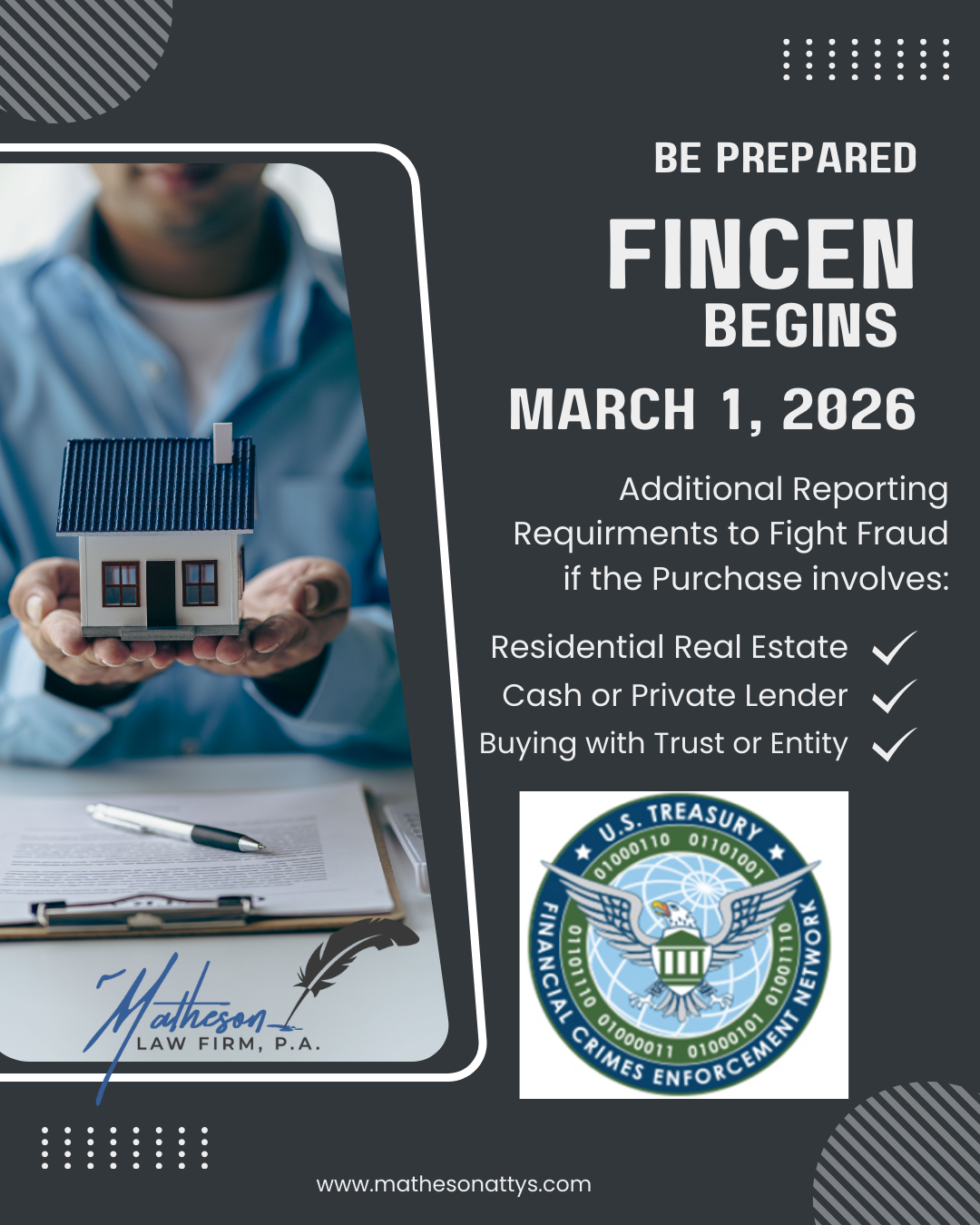
FinCEN Reporting began March 1, 2026 for the purchase of residential real estate using cash or private financing by a trust or other entity, such as a limited liability company (LLC).
Residential real estate encompasses any property that can be used for residential purposes, including multi-family buildings and vacant land that can be developed into residential real estate.
Cash or private financing triggers reporting. If a trust or entity uses an institutional lender that underwrites the loan using approved FinCEN requirements, then there is no reporting requirement by the closing attorney or settlement company.
Other Exempt Transactions include:
A grant, transfer, or revocation of an easement.
Transfers that result from an individual's death, such as through a will, trust, or operation of law (e.g., intestate succession or transfer-on-death deeds).
Transfers that are part of a divorce or the dissolution of a marriage.
A transfer to a bankruptcy estate.
Any transfer that is supervised by a U.S. court.
Transfers made by an individual (or with their spouse) to their own trust for no consideration.
Transfers involving a qualified intermediary (QI) as part of a like-kind exchange under Section 1031 of the Internal Revenue Code.
A transfer where no reporting person is involved in the transaction.
For a reportable transaction, the buyer and seller will receive an online form that must be completed prior to closing. This form will collect information regarding the following:
Type of purchasing entity
The relationship of the person completing the form to the entity
Whether any exemptions apply
The name, address and tax identification number of the entity
Information on the beneficial owner(s) of the entity, including name, address, date of birth and social security number
For the Buyer only, the payment amount, method (check or wire), and payment source (account information) of each payment related to the transaction
The form will be signed under penalty of perjury.
NOTICE: On March 1, 2026, the data collection and reporting requirements under the U.S. Financial Crimes Enforcement Network (FinCEN) new Anti-Money Laundering Rule (Rule) went into effect. The Rule applies to certain residential real estate sale transactions (including some that go beyond the typical one-to-four family residence) where the transfer is to a legal entity or trust, and which includes cash purchases, private financing or financing provided by an institution not subject to a federal Anti-Money Laundering or Suspicion Activity Report requirement. As part of this Rule, buyers and sellers are required to provide additional information and documentation about themselves, their legal entities, and/or the source of funds used in the reportable transaction. The collection of this information and documentation is required to comply with the Rule’s federal reporting requirements.
Choose Matheson Law Firm
At Matheson Law Firm, we understand that the North Carolina real estate closing process can be complex. Our personalized services help the process go smoothly and efficiently. Our real estate attorneys are responsive to your inquiries, offer secure document exchange, and provide convenient closing times. Plus, we’ll coordinate efforts between buyers, sellers, agents, and lenders for a fair transaction.
If you’re in the greater Charlotte area, contact us today to speak with an attorney about handling your real estate closing with the professionalism and attention it deserves.